What to Expect at a Same-Day CEREC Crown Appointment
Posted on 9/9/2026 by Singing River Dentistry Madison |
 If you’re wondering what to expect at a same-day CEREC crown appointment in Madison, AL, the short answer is that one visit replaces what used to be two. A CEREC crown compresses what was once a two-appointment, multi-week process into a single visit of roughly two hours. You walk in with a tooth that needs a crown and walk out the same day with the permanent restoration cemented in place. No temporary to wear home, no second visit on the calendar, no impressions sent to an outside lab.
That convenience is the headline, but the real reassurance comes from walking through the visit step by step. In this article, we’ll explain what happens during each stage of a CEREC same-day crown appointment at Singing River Dentistry, what you’ll feel, what you’ll see, and what to expect after you head home.
On This Page
Two Appointments Compressed Into One
A traditional crown has always taken two visits and roughly two to three weeks. At the first appointment, the tooth is prepared, impressions are taken, and a temporary crown is placed. Those impressions get sent to an outside lab where the permanent crown is fabricated, and you return a couple of weeks later to have the temporary removed and the new crown cemented in place.
CEREC technology folds that entire workflow into a single appointment. A small 3D scanner replaces the goopy impression material, design software replaces much of the lab technician’s manual work, and a small milling unit in our office carves the crown from a solid block of ceramic while you wait. The end result is the same kind of high-strength, color-matched restoration you’d get from a traditional lab process, but it’s finished in about two hours instead of two weeks. You can read more about our in-office dental technology to see how the full system fits together.
What Happens During Your Visit
Most CEREC appointments at our Madison office run between ninety minutes and a little over two hours, depending on the tooth and the complexity of your bite. Here’s what each stage looks like in practice.
Arrival and shade match
The visit starts with a quick review of your case. Our team will go over the plan, answer any last questions, and check your bite to make sure nothing has changed since your last visit. We’ll also choose a shade for the new crown by holding small ceramic tabs next to your neighboring teeth in good lighting and picking the closest match. Final aesthetics are decided here, not later, so it’s worth taking a careful minute on this step.
Numbing and tooth preparation
Local anesthesia is delivered next. Most patients feel the small pinch of the numbing and then nothing else for the rest of the appointment. Once the tooth and surrounding tissue are fully numb, our dentist reshapes the tooth to make room for the crown, removing any decay or weakened structure along the way. This stage usually takes fifteen to thirty minutes depending on what we find. You’ll hear the handpiece and feel some vibration, but no discomfort.
Digital scanning and crown design
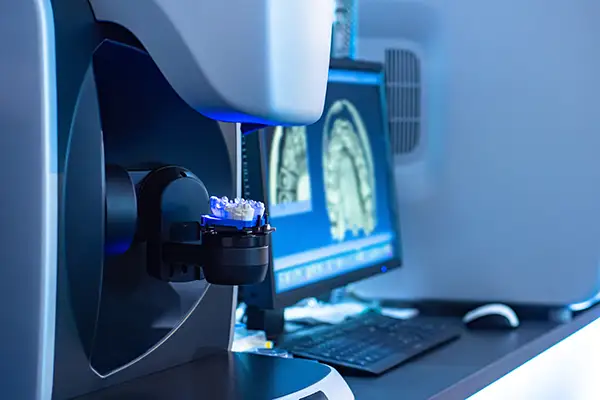 With the tooth ready, a small wand-shaped scanner glides over the prepared tooth and the surrounding teeth to capture a precise 3D image of the area. A few passes is usually enough, and the digital model appears on the screen within seconds, with no impression tray and no setting time. From there, our team uses CAD software to design the crown digitally, matching the contour, the contact points, and the bite to the rest of your mouth. Most patients watch this part on the chairside monitor, which makes the next step easier to picture.
In-office milling
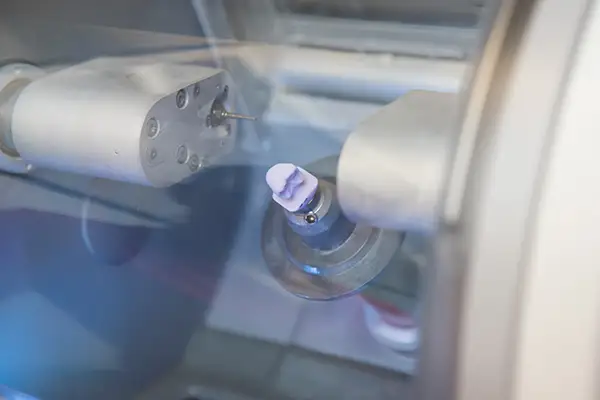 Once the design is finalized, it’s sent to the milling unit, where small diamond burs carve your crown out of a solid block of dental ceramic. The block goes in plain and the crown comes out in roughly fifteen to twenty minutes. This is the stretch of the appointment where you can relax. Most patients scroll their phone, watch something on the chair’s screen, or step out for a quick coffee on a longer mill. You don’t have to keep your mouth open the whole time, and no extra work is happening on the tooth during this window.
Fit check and cementation
The freshly milled crown comes back to the chair for a trial fit. Our dentist checks how it seats on the tooth, how it contacts the teeth next to it, and how it meets your bite when you close. Small adjustments are made with a polishing tool if needed. Once the fit is right, the crown is glazed and polished for a natural sheen, then bonded to your tooth with a permanent dental cement. The bite is checked one more time after cementation, and you’re done.
What to Expect After You Leave
The numbness from the anesthesia wears off gradually over the next two to four hours. Until it does, you’ll want to avoid chewing on that side so you don’t accidentally bite your cheek or tongue. Most patients head straight back to their normal day right after the appointment.
Some light sensitivity to cold on the newly crowned tooth is common for a day or two as the tooth settles around the new restoration. Mild tenderness around the gum at the edge of the crown is also normal for a short window. An over-the-counter pain reliever taken before the numbness fully wears off is usually all most people need.
For the first day or two, sticky candies and very hard foods are worth steering around on the new crown, just to give the cement time to fully cure. After that, the crown is treated exactly like a natural tooth. You brush and floss it normally, and routine cleanings keep the surrounding gum tissue healthy. If the bite feels uneven once the numbness is gone, give us a call. A one-minute adjustment is all it usually takes to fine-tune it.
When CEREC Is the Right Fit
CEREC works beautifully for most single crowns, especially on back teeth where strength and accurate bite are the top priorities. It’s also a strong option for replacing older, failing crowns where the underlying tooth is still healthy enough to support a new restoration. You can compare the different materials we use in our overview of the types of dental crowns we offer.
There are a few situations where a traditional lab-fabricated crown still has the edge. Some highly aesthetic front-tooth cases benefit from the layering work that a skilled ceramist can do by hand, especially when the surrounding teeth have subtle color variation that’s hard to replicate from a single ceramic block. Certain bridge cases also benefit from lab fabrication. During your consultation, our team will tell you honestly whether a same-day tooth crown is the right call for your specific tooth, or whether one of the lab-based options would serve you better.
Planning Your Same-Day Visit
A same-day CEREC crown is straightforward, predictable, and a real time-saver for most patients, but knowing what to expect at each stage is what turns the visit from stressful to manageable. If you’re thinking about a same-day crown in Madison, the team at Singing River Dentistry is happy to walk you through the full picture during a consultation. Give us a call at 256-653-9830 or request an appointment when you’re ready.
Frequently Asked Questions
How long does a CEREC crown appointment really take?
Most CEREC visits run between ninety minutes and a little over two hours, with about fifteen to twenty minutes of that being passive time while the milling unit is making the crown. The exact length depends on the tooth, how much preparation it needs, and the complexity of your bite. We’ll give you a realistic estimate when we plan the visit.
Does a same-day CEREC crown last as long as a lab-made crown?
A well-placed CEREC crown is comparable in longevity to a traditional lab-fabricated crown made of the same material. Modern dental ceramics are very strong, and the digital design process produces precise fit and contacts. As with any crown, lifespan depends heavily on home care, your bite, and habits like clenching or grinding.
Will my dental insurance treat a CEREC crown differently?
Most dental insurance plans treat a CEREC crown the same way they treat any other porcelain or ceramic crown, since the end product is a permanent crown. Coverage varies by plan and by the type of material used. Our front desk team is happy to review your benefits with you ahead of the appointment so there are no surprises.
Is the milling machine noisy or distracting during the appointment?
The milling unit makes a steady whirring sound, similar to a small kitchen appliance, while it carves the crown. Most patients find it quieter and less intrusive than typical chairside instruments. Because the milling happens during a passive part of the visit, you can wear earbuds, watch something on the chair’s screen, or simply rest.
What if I need a crown on a very visible front tooth?
CEREC works well for many front-tooth crowns, especially when the neighboring teeth have a fairly uniform color. For cases where the surrounding teeth show subtle layered shading, a lab-fabricated crown with hand-layered ceramics may give a slightly more lifelike match. Our team will look at your specific case and recommend the option that delivers the best aesthetic result. |
|

